Framework + paper
ATM: CID-Brokered Pre-Write Admission for Multi-Agent Code Co-Synthesis
A usable engineering framework first, and a paper-backed governance model second, for deciding before a governed shared write is applied.
ATM reframes concurrent AI code writing as a pre-write admission problem. Instead of waiting for Git merge, failing validators, or human review to discover conflicts after the fact, the framework compares structured write intents before a governed shared mutation lands.
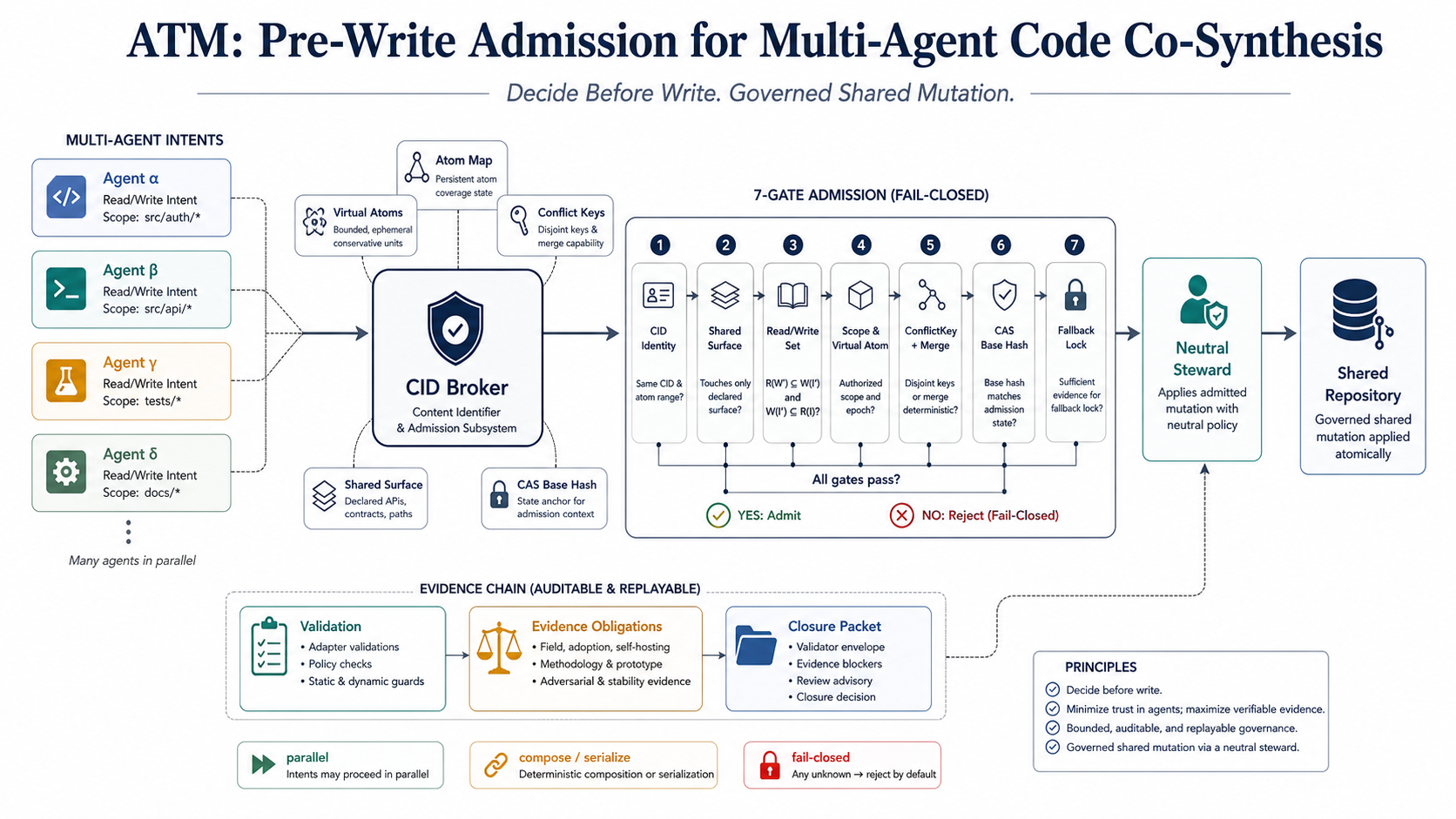
What problem does the paper address?
Multi-agent LLM systems can plan, generate, validate, and repair software, but a narrower systems question remains unresolved: before any governed shared mutation is applied, how should a system decide which concurrently formed write intents may proceed in parallel, which require deterministic composition or serialization, and which must take a fail-closed path?
ATM binds task intent, repository scope, write admission, validation, and evidence obligations into a single governance chain. A Content Identifier (CID) broker compares structured write intents with support from atom maps, virtual atoms, ConflictKeys, shared-surface checks, read/write dependency checks, and CAS base-hash revalidation. Governed shared writes are then applied by a neutral steward.
In practice, the framework matters as much as the paper: the engineering value is that ATM gives builders a concrete way to route concurrent agent writes, preserve bounded governance, and keep shared-repository coordination from collapsing into ad hoc merge-time cleanup.
Claim boundary
- ATM does not replace Git merge.
- ATM does not claim cross-clone or cross-PR governance.
- ATM does not claim universal semantic correctness.
- ATM does claim an implementable and auditable pre-write admission layer within one governance domain.
Why this paper may be useful
If you are building coding-agent systems, agent orchestration layers, or repository-level AI workflows, the paper gives you a concrete framing for one problem that often arrives too late in downstream tooling: deciding when shared writes should be admitted before they mutate the governed surface.
FAQ
Git merge resolves divergence after versions already exist. ATM intervenes earlier, before a governed shared write is applied inside one controlled domain.
CRDTs solve text-level convergence. ATM focuses on repository-governance admission using atoms, virtual atoms, shared surfaces, and evidence obligations.
No. The paper explicitly scopes itself to a single authority governance domain.
The official paper is now live on arXiv at arXiv:2607.00041. This landing page remains the companion hub for framework links, figures, and artifacts.
Share Kit
If you want to post ATM to Hacker News, Reddit, X, Discord, or a project log, this section gives you one reusable visual and two messaging tracks: a framework-first track for engineering communities and a paper-first track for research-facing posts.
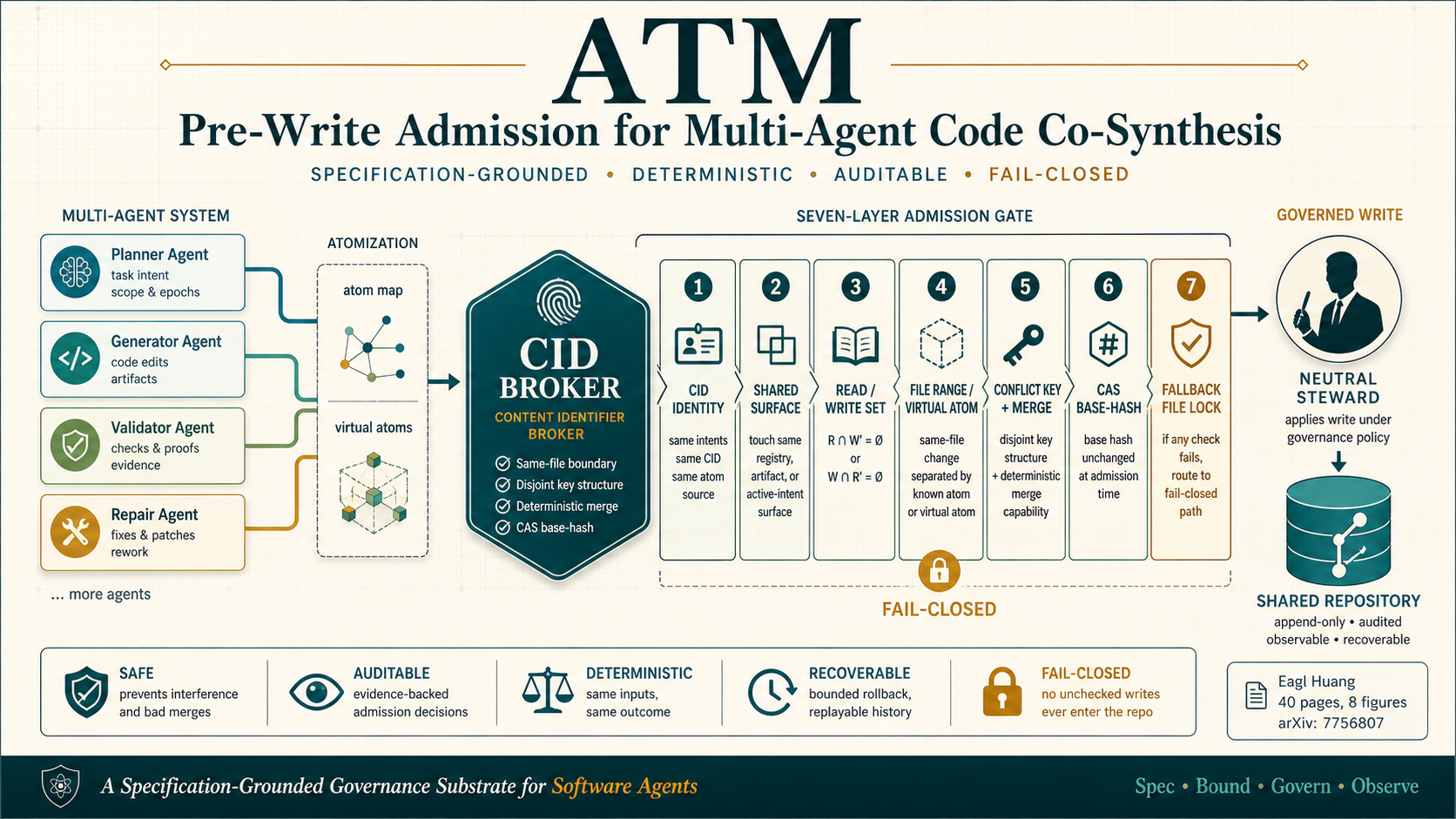
I built ATM, a governance framework for multi-agent coding, to solve a practical repo problem: before a shared write lands, how should the system decide which concurrent agent changes can proceed in parallel, which must serialize, and which should fail closed?

The framework uses a CID broker, atom-map-guided comparison, virtual atoms for partial coverage, shared-surface checks, and a neutral steward apply path. The paper is there to make the model precise, but the main thing I want people to look at is the engineering workflow and whether this kind of pre-write governance is useful in real multi-agent repos.
I built ATM, a multi-agent coding governance framework for deciding before shared writes land which concurrent changes can proceed, which must serialize, and which should fail closed.

The repo is the main thing. The paper just gives the model and claim boundary more structure.
We posted a paper on a narrower systems problem in multi-agent coding: before a governed shared write is applied, how should a system decide which concurrently formed write intents may proceed in parallel, which require deterministic composition or serialization, and which must take a fail-closed path?

The paper presents ATM, a single-domain pre-write admission layer with a CID broker, atom-map-guided comparison, virtual atoms for partial coverage, and a neutral steward apply path. The scope is intentionally narrow: this is not a claim about cross-clone governance or universal merge replacement.

Paper: https://arxiv.org/abs/2607.00041
New paper: ATM: CID-Brokered Pre-Write Admission for Multi-Agent Code Co-Synthesis.

It asks a narrower question than “can agents write code?”: before a governed shared write lands, how should a system decide which concurrent write intents can proceed, which must serialize, and which must fail closed?

Single-domain scope, conservative claims, public code + artifacts linked from this page.

Paper: https://arxiv.org/abs/2607.00041